German hoist manufacturer Geda has announced what it claims is a “groundbreaking innovation for transporting people and materials on construction sites.” UpDate: This claim has now been challenged by Böcker, which has provided these changes since 2024 - See: Not the first speeder!.
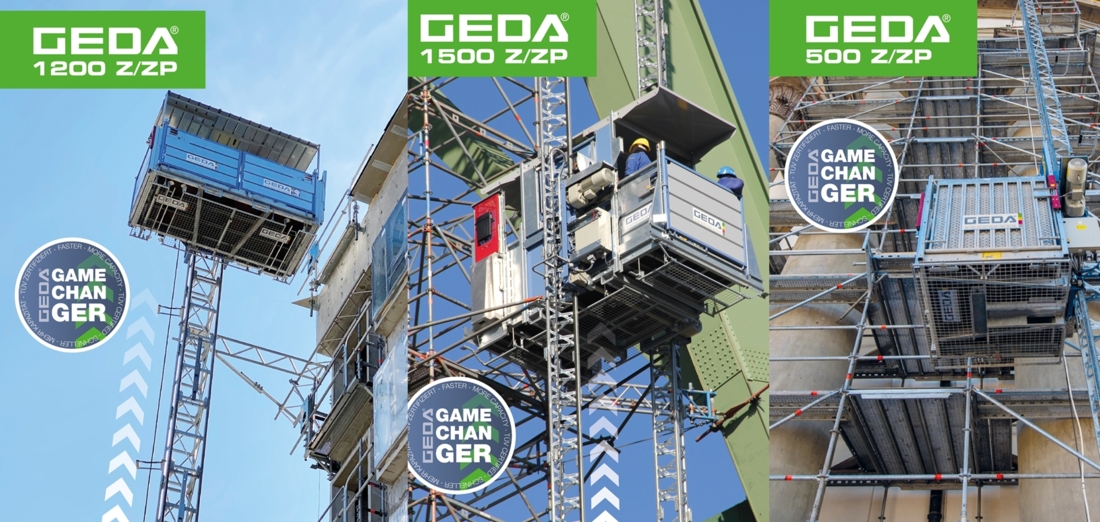
It has substantially increased the permitted lift speeds and passenger capacity on its range of Transport Platforms, which can carry either materials or people, ignoring limits set in the applicable European standard EN 16719.
Lift speeds on the Geda 500 Z/ZP, 1200 Z/ZP, and 1500 Z/ZP models will double from 12 to 24 metres per minute, while on the Geda 2500 Z/ZP it will increase from 12 to 40 metres per minute and the 3700 Z/ZP will go from 12 to 36 metres per minute.
The passenger capacity previously limited to a maximum of seven has increased as follows: the Geda 1200 Z/ZP, will now manage 11 passengers, while the 1500 Z/ZP, rises to 17, the 2500 Z/ZP is increased to 13, and the 3700 Z/ZP will take up to 30 passengers - depending on the platform variant.
The 12 metres a second and seven passenger restriction are included in the EN 16719 standard for Transport Platforms, while dedicated passenger hoists include more safety-related restrictions and technology and more enclosed platforms/cars are covered by the EN 12159 standard.
A product that conforms to its applicable standard signifies compliance with all relevant aspects of the legally binding Machinery Directive, but it is not the only way to comply with the directive.
This time last year, IPAF issued a comprehensive statement on the matter See: IPAF official Statement.
It seems that Geda has chosen to use the notified body TÜV to inspect, type-test risk assess and approve certification and compliance directly with the Machinery Directive to allow the higher speeds and capacities, rather than self-certifying to the EN 16719 standard as it relates to lifting people, allowing it to increase lift speeds and the number of passengers carried.
Geda’s introduction statement announcing the changes, which come into effect immediately, includes the line: “Animal like strength. Technologically integrated into Geda transport platforms. The speed of a cheetah. The capacity of an elephant. The efficiency of ants.”
Geda added: “The benefits are clear: Shorter travel times reduce waiting and cycle times, improving passenger flow to help make workflows more efficient. Especially for taller buildings and large construction projects, the time saved over the course of an entire workday can make a decisive contribution to cost effectiveness.”
“The demands on construction site logistics are constantly increasing. Construction timelines are getting shorter, projects are becoming more complex, and efficient processes are increasingly becoming a decisive competitive factor. The vertical transport of people and materials, in particular, plays a central role in this context.”
“With higher travel speeds and optimised passenger capacity, Geda addresses precisely this need. Rather than simply refining individual machine components, the company takes a holistic view of the entire construction site process and creates solutions that deliver tangible added value in day to day use.”
“Geda sees itself not only as a manufacturer of aerial access solutions, but also as a long-term partner to construction companies and rental firms. Decades of experience, close collaboration with users, and a deep understanding of real world requirements form the foundation for solutions that make construction sites safer, more efficient, and more cost-effective.”
“More than 25 years ago, Geda played a key role in the development of the EN 16719 standard, which set new standards for the safe transport of people and materials on construction sites. Then as now, the company pursues a clear goal: to develop safe, high performance, and future oriented solutions for access at height.”
The company has also issued the following video
Vertikal Comment
This move seems somewhat cavalier and has already caused consternation and surprise amongst many in the greater European hoist/transport platform industry, while putting competitors and contractors on the spot as to how to react.
It has been said that an increasing number of contractors have been using the platforms at higher speeds and that Geda is accepting that this is happening anyway, and it is better to introduce the changes they want, but in a formal, checked and verified manner rather than a site by site ‘override’ type situation.
It will be very interesting to see how organisations such as IPAF, and other hoist manufacturers react, and whether this eventually triggers an updated standard? After all, there is nothing sacred about 12 metres a minute or seven passengers. But this is not the best way to change things.
the advisor
Leigh first of all these machines run at 12 m per min not second
Then we have to understand that to do this currently on site it is miss use as the control station point changes to the ground position to reach the new speeds stated on current machines
As the principal contractor is responsible for safety in the UK under CDM regs it will be hard to justify these changes as all UK guidance and the Update of the British standard 7212 clearly gives details of responsibilities and requirements
Then they are putting even more responsibility on the operators of these new machines to keep other people safe and how and what standards will these operators to be certified to and how do you prove the competency to operate such new machines as you say IPAF have already issued warnings here
Then with the new speed increase how are these machines compliant to ISO 13857 around guarding hazards
So i say buyer be aware if you are thinking of going down this route then clearly understand what liabilities you are taking on by purchasing and supplying such equipment into your country
This is not good for our industry that has strived to increase safety yet now a manufacturer is going against all the work done to get to this point just wrong i thought better of them
Maybe the UK dealer & IPAF training Centre will give a better update
I also hope they have fully updated any manuals to clearly show the changes and clear risks associated with such changes





vertikal editor
Your input is, as always, very much appreciated, 'the advisor' and precisely what these comment sections are intended for.
the advisor
Leigh first of all these machines run at 12 m per min not second
Then we have to understand that to do this currently on site it is miss use as the control station point changes to the ground position to reach the new speeds stated on current machines
As the principal contractor is responsible for safety in the UK under CDM regs it will be hard to justify these changes as all UK guidance and the Update of the British standard 7212 clearly gives details of responsibilities and requirements
Then they are putting even more responsibility on the operators of these new machines to keep other people safe and how and what standards will these operators to be certified to and how do you prove the competency to operate such new machines as you say IPAF have already issued warnings here
Then with the new speed increase how are these machines compliant to ISO 13857 around guarding hazards
So i say buyer be aware if you are thinking of going down this route then clearly understand what liabilities you are taking on by purchasing and supplying such equipment into your country
This is not good for our industry that has strived to increase safety yet now a manufacturer is going against all the work done to get to this point just wrong i thought better of them
Maybe the UK dealer & IPAF training Centre will give a better update
I also hope they have fully updated any manuals to clearly show the changes and clear risks associated with such changes
Oh but this is just my thoughts of course
Regards Keith