32 people have died, and 64 are reported to have been injured this morning at 09:13 local time in Nakhon Ratchasima, Thailand, when a launching crane collapsed onto a moving train with around 200 passengers on board, predominantly students and commuters, with the youngest injured reported to be just a year old.
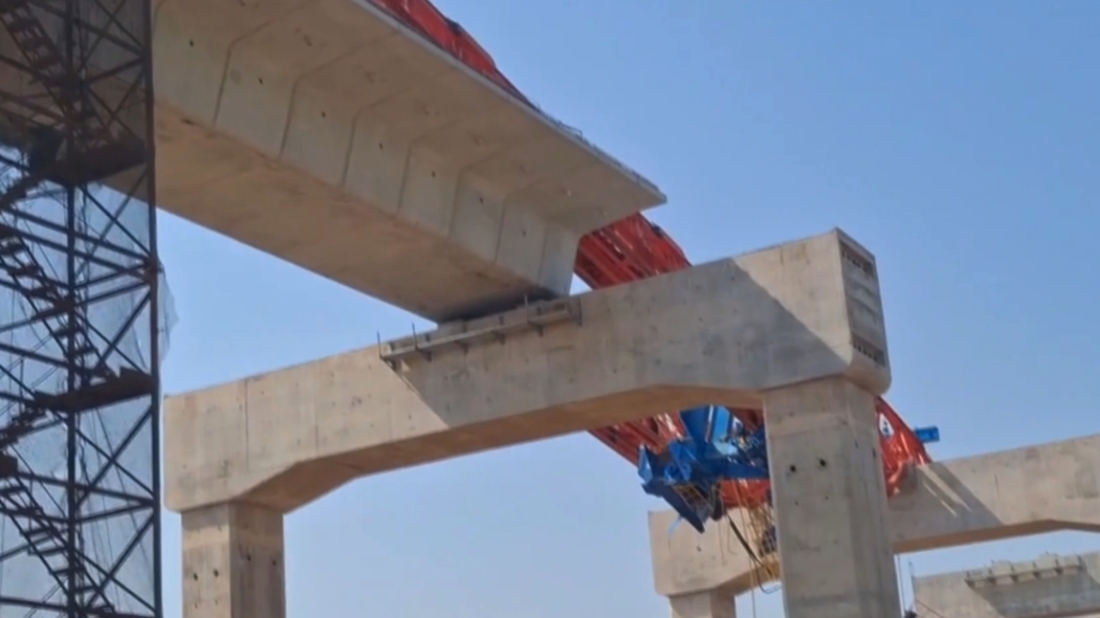
A closer view of the failed crane element
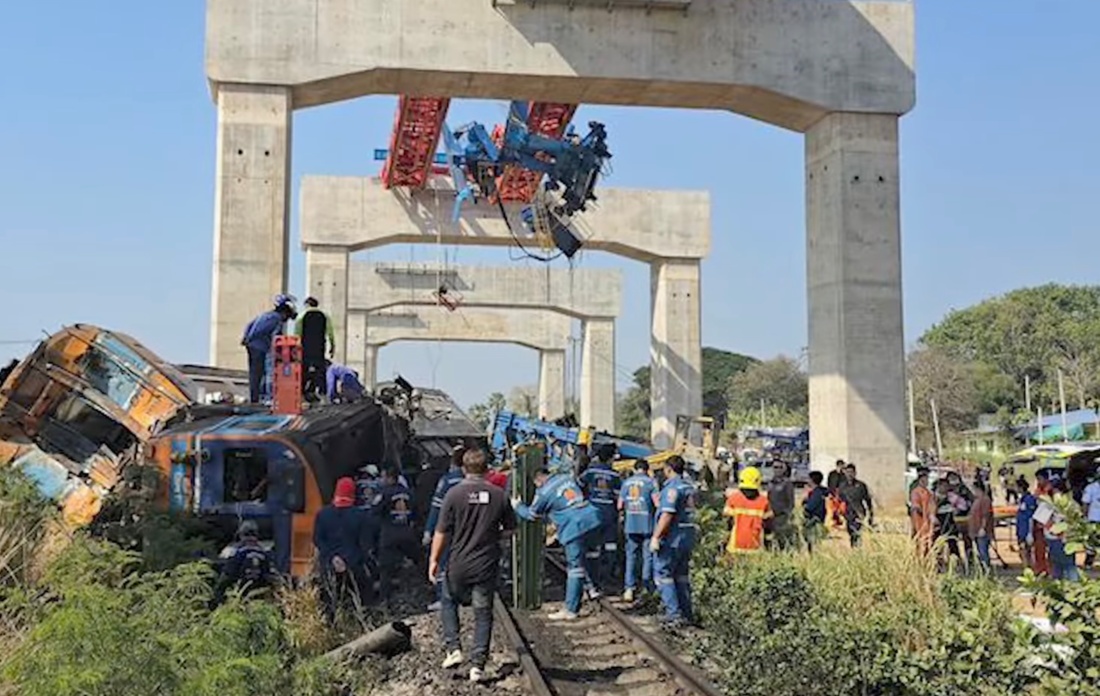
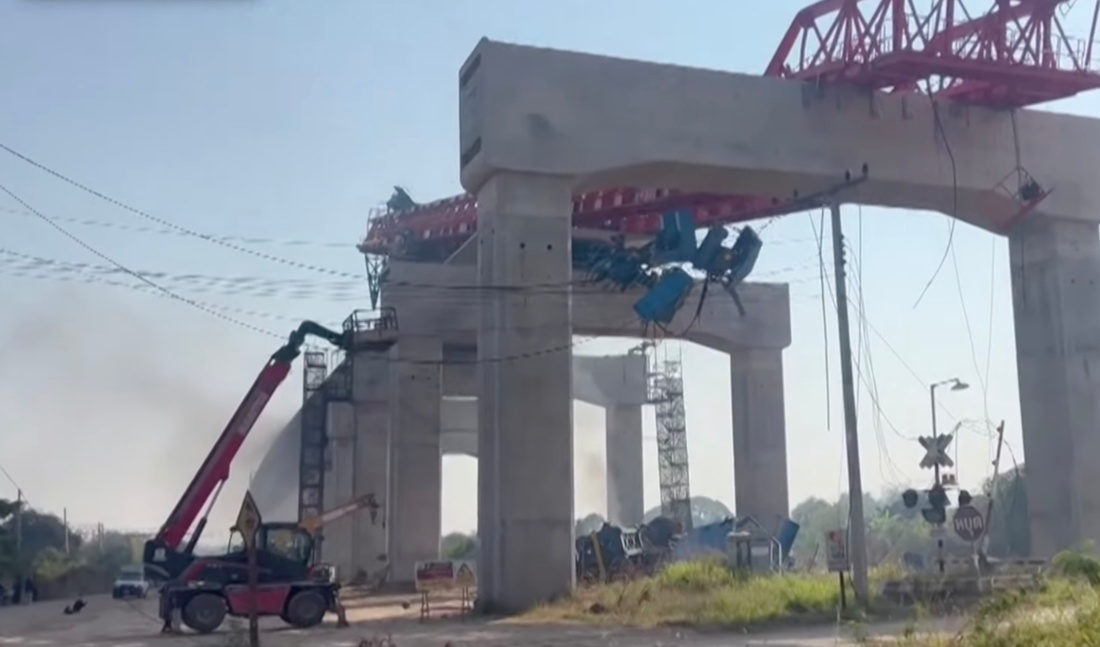
The express train, travelling west from Bangkok to Ubon Ratchathani, was passing through Ban Thanon Khot in Nakhon Ratchasima province, north west of the capital, at a speed of around 120kph when the crane dropped onto the centre of the second carriage, literally ‘slicing it in half’, causing other carriages to derail and catch fire. Most of the casualties were travelling in the second carriage.
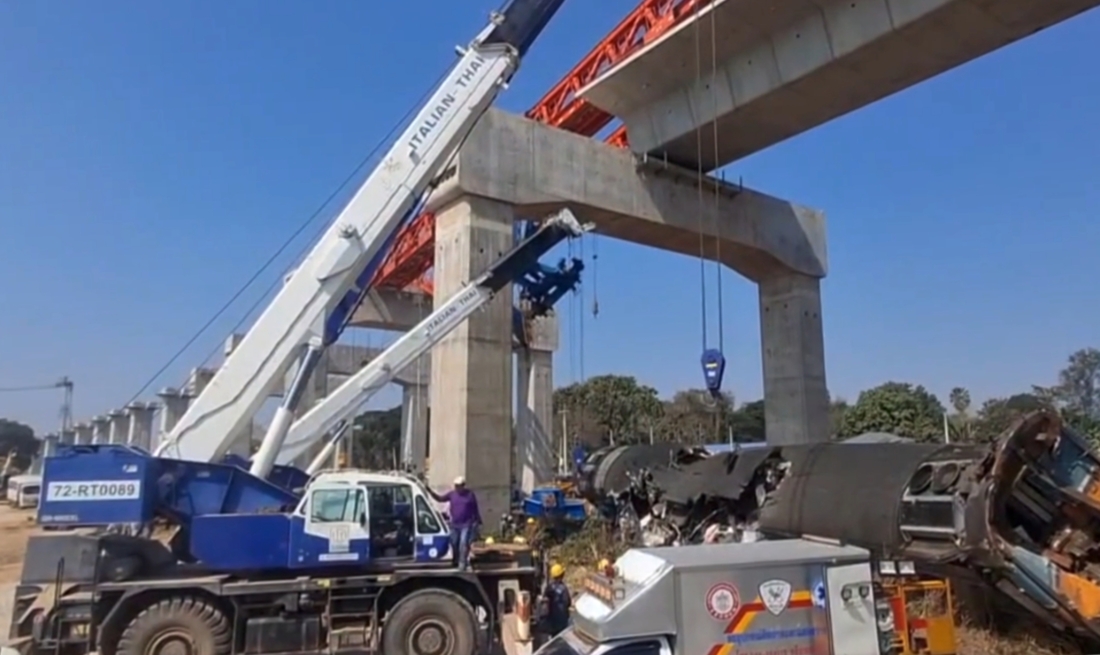
The crane was working on the Lam Takhong-Sikhio section of the £4 billion high speed rail project, which aims to connect Bangkok to Kunming in China by 2028. The project is being managed by the Italian-Thai Development Company (ITD) - one of Thailand’s largest contractors - and the China Railway Engineering Corporation (CREC). The ITD is responsible for the section where the incident occurred. It looks as though the travelling load-carrying component of the crane broke free of the overhead girder beams. But it is far from clear.
The recovery work gets underway
Thai prime minister Anutin Charnvirakul issued a statement which said: “Accidents like this can only happen due to negligence, skipped steps, deviations from the design, or the use of incorrect materials. We need to investigate whether there were any construction errors or deviations from proper procedures."
Vertikal Comment:
Looking back through our news reports over the past 25 years, it is hard not to draw a conclusion that bridge section launching cranes are inherently dangerous.
However, it is risky to draw such a conclusion without knowing how many of these ‘cranes’ are actually in operation at any given time - certainly far fewer than tower or mobile cranes. This is not a crane type that we routinely cover, and to a large extent, we remain somewhat unfamiliar with both the market and the technology.
Nevertheless, it has to be said that, unlike mobile cranes and, to a lesser extent, tower cranes, the conditions and circumstances for launching cranes are highly consistent and known well in advance. No turning up on site on the day of the lift to find that things have changed.
As such, the work can be meticulously planned, and if the lift plan is followed in the same way that a flight crew works, there should be few excuses for such an incident. It will be interesting to learn what the cause of this tragic incident was... but it is hard not to assume poor planning and supervision. Let us not pre-judge, though.
Chief
Terrible tragedy. I don't know much about this system apart from TV documentaries. However you don't need much common sense to know not to have heavy lifting operations over busy live road or rail traffic just as you have exclusion zones for any lifting operations. Just look at YouTube construction videos in Thailand and you can see why these incidents happen. I hope those responsible spend a long time behind bars.









Chief
Terrible tragedy. I don't know much about this system apart from TV documentaries. However you don't need much common sense to know not to have heavy lifting operations over busy live road or rail traffic just as you have exclusion zones for any lifting operations. Just look at YouTube construction videos in Thailand and you can see why these incidents happen. I hope those responsible spend a long time behind bars.